
Modern non-surgical hair replacement offers several ways to achieve a fuller-looking hairstyle without undergoing a hair transplant.
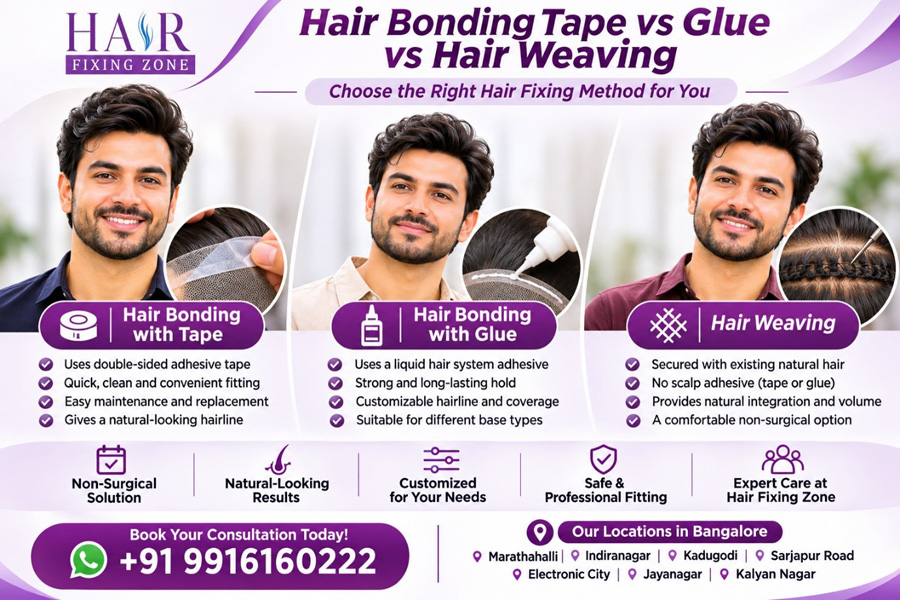
Among the popular options for men are hair bonding with tape, hair bonding with glue, and hair weaving. Although all three methods are used for non-surgical hair fixing, their attachment techniques, maintenance requirements, and suitability are different.
Choosing the right method is not just about securing a hair patch. It is about finding the right balance between natural appearance, comfort, lifestyle, scalp care, and long-term maintenance.
Let's understand how each method works and which one may suit your requirements.
This is one of the most important decisions when choosing a non-surgical hair replacement system.
Hair bonding with tape or glue is particularly useful when you need coverage over a bald area without depending on surrounding hair for attachment.
Hair weaving is worth considering when you have sufficient healthy natural hair around the coverage area and prefer an attachment technique that avoids scalp adhesives.
Consider your requirements:
The final decision should be based on scalp condition, existing hair density, hair system design, and professional assessment.
Comfort depends on several factors, including hair system weight, base material, attachment quality, scalp condition, and maintenance.
Tape bonding can offer a convenient attachment arrangement, while liquid glue can be customized for different base designs. Hair weaving avoids scalp adhesive but requires suitable natural hair to support the system.
If you regularly work out, travel, spend time outdoors, or experience excessive sweating, discuss your routine before selecting an attachment method.
Do not assume that any method is completely maintenance-free or suitable for every activity.
Maintaining your hair system correctly helps preserve its appearance and comfort.
If you notice burning, persistent itching, redness, swelling, or pain, stop using the attachment method and seek appropriate professional advice. Certain hair adhesives can cause skin irritation or allergic contact dermatitis, while excessively tight weaves can contribute to traction-related hair loss.
The cost of non-surgical hair fixing varies according to several factors:
Instead of comparing only the initial fitting price, consider the overall maintenance expenses and the quality of the hair system.
A professional consultation can help you understand the available options and their costs.
At Hair Fixing Zone, we understand that every man has different hair replacement requirements.
Our non-surgical hair replacement services include customized hair patches, hair bonding, hair weaving, and clip-in hair systems.
We help customers explore suitable hair systems based on their hair loss pattern, desired coverage, hair texture, hairstyle, and personal preferences.
Whether you are considering tape bonding, glue bonding, or hair weaving, understanding the available methods is the first step towards making an informed decision.
Hair bonding tape uses double-sided adhesive strips, while hair glue uses a liquid adhesive. Both attach a hair system, but application, removal, and maintenance differ.
Neither is universally better. Tape may offer convenient adhesive replacement, while liquid glue allows different application styles. Compatibility with the hair system and scalp is important.
Traditional non-adhesive hair weaving uses existing natural hair to secure the hair system and does not require scalp glue. The exact technique varies.
Traditional weaving requires suitable existing hair for anchoring. Men with extensive or complete baldness may need to consider a bonded or other suitable hair system.
Yes, but the timing and washing routine depend on the adhesive used and the professional fitting instructions. Always follow the aftercare guidance.
Phone / WhatsApp: +91 9916160222
Email: info@hairfixingzone.com